FDW Wireless Networking - XG and Beyond
VT-ARC worked closely with OUSD(R&E)/BRO to identify top researchers from the wireless communications and next-gen wireless fields to serve as co-chairs and participants. We used data analytics on open-source data to identify the most prominent researchers and then conducted interviews of prospective candidates with OUSD(R&E)/BRO. We then worked with the workshop co-chairs to select subtopics, design the workshop, and select participants that represented a diversity of discipline and thought. The final list of participants included 19 researchers across academia, industry, and government. There were also a total of 11 government observers at the workshop.
The participants identified the urgent need to reimagine wireless systems as adaptive, intelligent, and resilient infrastructures critical to national defense. The workshop emphasized breaking traditional architectural boundaries by moving beyond rigid layering, fixed spectrum allocation, and centralized control, toward architectures that are learning-enabled, spectrum-agile, and application-aware. Participants called for a convergence of disciplines spanning RF engineering, control theory, AI/ML, sensing, and cybersecurity to create systems that autonomously manage interference, adapt in real time, and operate securely in dynamic and contested environments. Key opportunities include the development of semantic communications, reconfigurable physical layers, and distributed AI for real-time decision-making. The report underscored the importance of interdisciplinary research, high-fidelity testbeds, and long-horizon investments to ensure future wireless systems can meet the complex, evolving demands of the 21st-century battlespace.
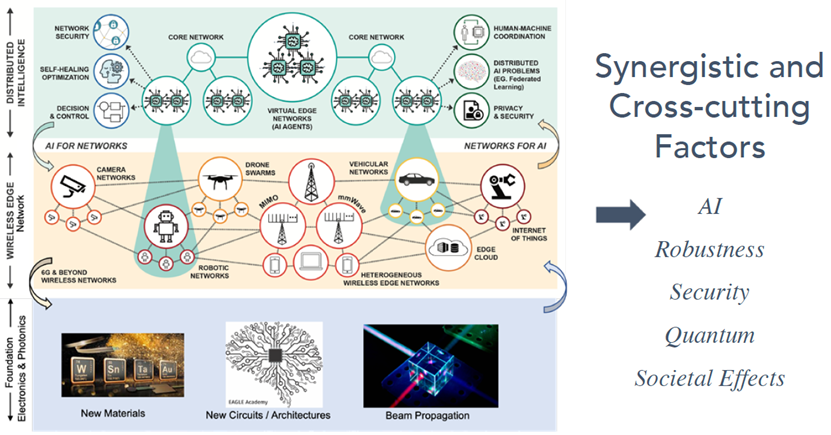
An example of a future wireless network that will integrate with intelligent systems (AI) is shown below.