FDW Toxicology
VT-ARC worked closely with OUSD(R&E)/BRO to identify top researchers from toxicological sciences to co-chair the workshop. We used data analytics on open-source data to identify the most prominent researchers. We then worked with the workshop co-chairs to select subtopics, design the workshop, and select participants that represented a diversity of discipline and thought. The final list of participants included 20 academic researchers, along with 10 government observers. VT-ARC managed the logistics for the workshop and provided rapporteurs to document discussions. We then worked closely with the workshop co-chairs to summarize the discussion into a high-quality report.
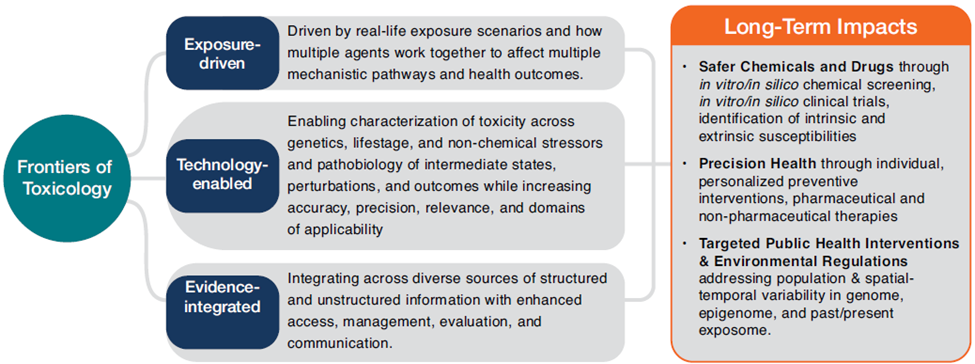
The report outlines a vision for “Toxicology 2.0,” integrating exposomics, advanced bioengineering (e.g., organ-on-chip systems), and artificial intelligence to understand how complex environmental and social exposures contribute to disease across diverse populations. The workshop emphasized transitioning to exposure-driven frameworks, leveraging emerging technologies to model human biology more accurately, and establishing interoperable data platforms for evidence integration. Long-term goals include enabling precision health, safer chemicals and drugs, and targeted environmental interventions through scalable, FAIR-compliant tools and probabilistic risk assessments. This vision requires coordinated investment in technology, ethics, data sharing, and public engagement to transform toxicology into a foundational science for 21st-century health and defense.
A summary of the three workshop topics and long term impacts are shown below.