FDW Controlled Living Organisms
VT-ARC worked closely with OUSD(R&E)/BRO to identify top researchers from biology and engineering disciplines to serve as co-chairs and participants. We used data analytics on open-source data to identify the most prominent researchers and then conducted interviews of prospective candidates with OUSD(R&E). We then worked with the workshop co-chairs to select subtopics, design the workshop, and select participants that represented a diversity of discipline and thought. The final list of participants included 20 researchers from the fields of broad controlled living organisms, control theory, complex system modeling, and dynamic systems. In addition, there were 11 government observers from multiple agencies.
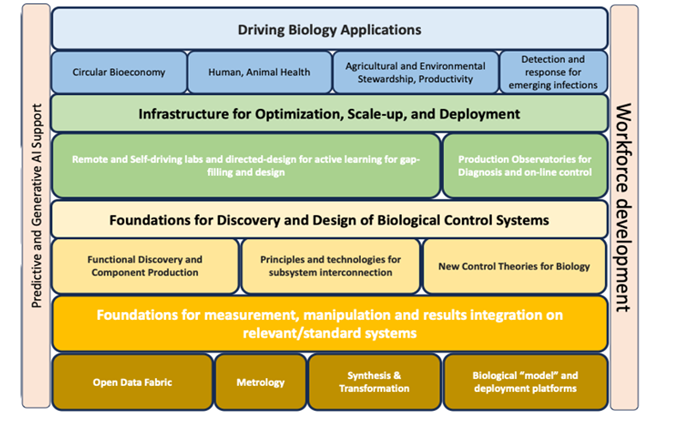
The participants explored how living systems (ranging from microbes to multicellular organisms) can be engineered and directed to perform specific functions in complex environments. They envisioned a future where biology is not only programmable but also predictable and responsive, enabling living systems to operate as sensors, actuators, or even computing substrates in defense-relevant contexts. Key priorities include understanding control mechanisms across biological scales, advancing synthetic and systems biology tools, and integrating living organisms with physical systems. The workshop emphasized interdisciplinary approaches that blend biology, control theory, materials science, and computational modeling. Achieving this vision will require investments in high-resolution measurement tools, scalable engineering frameworks, and robust ethical and security governance to ensure these transformative capabilities are both powerful and responsible. An “architecture” for the characterization, design, and control of living systems for applications within and beyond the bioreactor is shown below.