FDW Embodied Intelligence
VT-ARC worked closely with OUSD(R&E)/BRO to identify top researchers from both the United States and South Korea in the fields of robotics, intelligence, and computation to serve as co-chairs and participants. We used data analytics on open-source data to identify the most prominent researchers and then conducted interviews of prospective candidates with OUSD(R&E)/BRO. We then worked with the workshop co-chairs to select subtopics, design the workshop, and select participants that represented a diversity of discipline and thought. The workshop was held in Seoul, South Korea, and served as both a scientific and diplomatic exchange between the USA and South Korea, with a debriefing with the South Korean Ministry of Trade, Industry, and Energy. The final list of participants included 24 researchers (12 from each country) from the broad fields of soft robotics, machine learning, biology, evolution, physics, and engineering. In addition, there were 5 government observers from both the DoD and South Korea MOTIE. VT-ARC coordinated with the chairs to write the summary report.
The workshop participants explored how intelligence arises from the tight coupling of body, brain, and environment—challenging disembodied views of cognition dominant in AI and neuroscience. The report identifies embodied intelligence as a transdisciplinary frontier, requiring integration of robotics, control theory, cognitive science, soft materials, and biological systems to develop machines that can learn, adapt, and act robustly in the physical world. Key research opportunities include distributed sensorimotor control, learning through interaction, and novel hardware that blurs distinctions between controller and body. The workshop called for new foundational theories, shared platforms for experimentation, and long-term, convergent research environments. Realizing embodied intelligence at scale will require investment in physical instantiation and simulation co-design, as well as ethical frameworks for deploying adaptive, self-directed systems in defense and civilian domains.
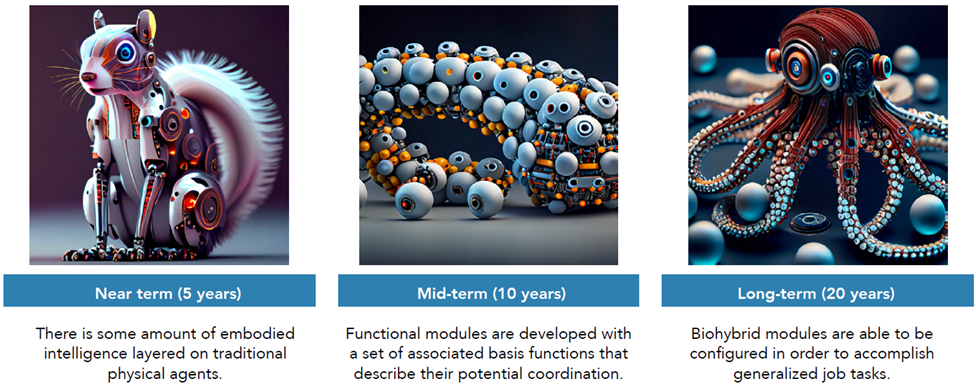
Visual representation of artificial systems at 5, 10, 20 years are shown below: