FDW Microelectronics
VT-ARC worked closely with OUSD(R&E)/BRO to identify top researchers from across the broad fields of materials, electrical engineering, and computational science to co-chair the workshop. We used data analytics on open-source data to identify the most prominent researchers and then conducted interviews of prospective candidates with OUSD(R&E)/BRO. We then worked with the workshop co-chairs to select subtopics, design the workshop, and select participants that represented a diversity of discipline and thought. The final list of participants included 25 academic researchers from the fields of anthropology, economics, political science, psychology and sociology. There were 11 government observers in attendance. VT-ARC managed the logistics for the workshop and provided rapporteurs to document discussions. We then worked closely with the workshop co-chairs to summarize the discussion into a high-quality report.
The workshop participants called for bold reinvention of microelectronics to sustain U.S. technological dominance amid rising global competition and diminishing returns from traditional scaling. They advocated for foundational research into materials, architectures, and algorithms that transcend Moore’s Law, focusing on hardware-software co-design, energy-efficient computing, and heterogeneous integration. Workshop participants emphasized leveraging cross-disciplinary advances in quantum science, neuromorphic engineering, and 3D integration to develop radically new paradigms for sensing, computing, and communication. Enabling this transformation will require open-access fabrication infrastructure, secure design workflows, and a robust talent pipeline that bridges device physics with system-level engineering. The report outlined a national imperative to reestablish leadership in microelectronics by investing in long-term basic research that supports innovation across the entire technology stack—from atomic-scale devices to intelligent, mission-ready systems.
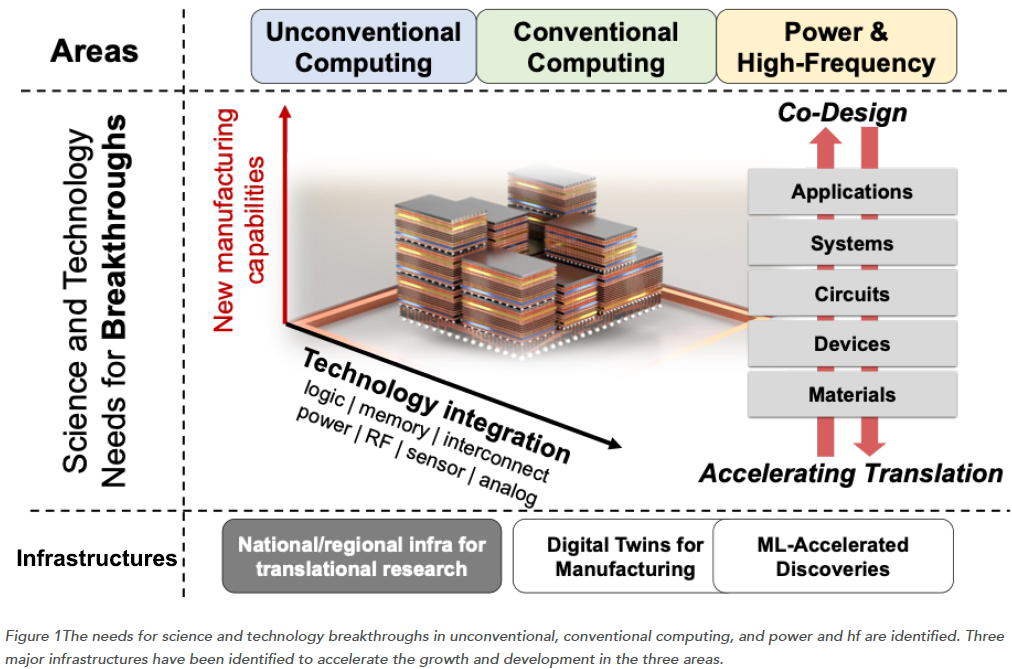
The figure to the right shows the need for science and technology breakthroughs in unconventional and conventional computing.
Microelectronics Roundtable
As a follow-on to the 2022 FDW on Microelectronics, VT-ARC worked with Dr. Supratik Guha to facilitate a follow-on roundtable discussion on September 25th, 2023, at the 2023 VBFF Summit held at the University of Chicago. Participants discussed findings from the workshop report, what had changed over the year since the workshop, and developed recommendations for the Basic Research Office to improve US microelectronics fabrication infrastructure. VT-ARC managed logistics for the event, provided facilitators and notetakers at the roundtable, and sent all slides and notes to Dr. Guha after the event so that he could create a briefing to the VBFF Summit audience and then draft a summary report. We also worked with Dr. Guha to finalize a slide deck briefing, which was presented to the Undersecretary of Defense for Research and Engineering in May 2024.
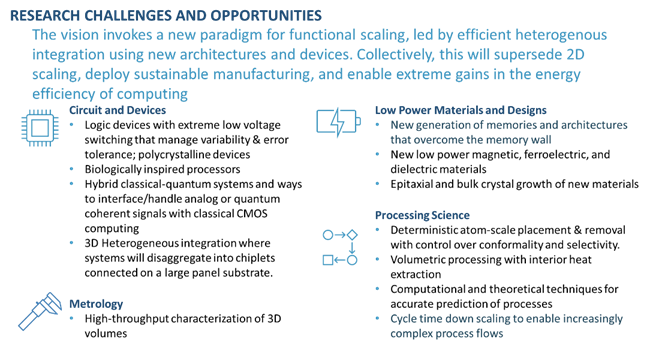
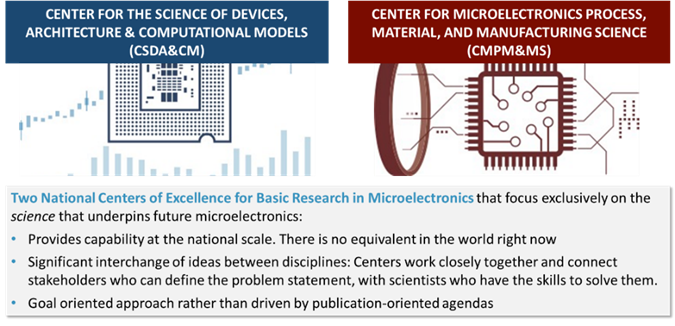
The report calls for renewed TRL 1–4 scientific investment to enable energy-efficient, scalable, and secure computing for the next 25 years. IT proposed two new centers: one center to focus on Process, Materials, and Manufacturing Science (PMMS) and the other to target Devices, Architectures, and Computational Models (DACM). These centers would advance breakthroughs in atom-scale fabrication, heterogeneous integration, unconventional logic and memory systems, and biologically inspired computation. The report emphasizes the need for physically co-located, interdisciplinary environments that integrate academic, industry, and government talent. It argues that without this long-term, collaborative infrastructure, the U.S. risks losing leadership in the technologies that underpin modern defense, health, AI, and climate solutions. Summary slides of the research challenges and opportunities, along with a breakdown of the two proposed centers are shown below.